An anchor point is only as strong as the fixing that holds it to the structure. A certified anchor bolted into weak concrete, a resin anchor that was never cleaned out properly, or an eyebolt in a crumbling mortar joint can all look perfect and still pull out under the force of a fall. A pull-out test is the only practical way to prove, on site, that an installed fixing will hold.
This guide explains what pull-out testing is, why it matters for fall protection and other safety-critical fixings, which standards apply, and what a good test regime looks like.
In short: a pull-out test uses a calibrated hydraulic tester to apply a controlled tension load to an installed anchor and checks that it holds without movement. For fall protection anchors in solid structures, UK guidance (BS 7883 and WAHSA) uses a 6 kN load held for 15 seconds. For post-installed anchors in general, BS 8539 sets proof loads of 1.5 × the design load on 2.5% of anchors, or 1.25 × on 5%. Test after installation, and re-examine anchors at least every 12 months.
What is a pull-out test?
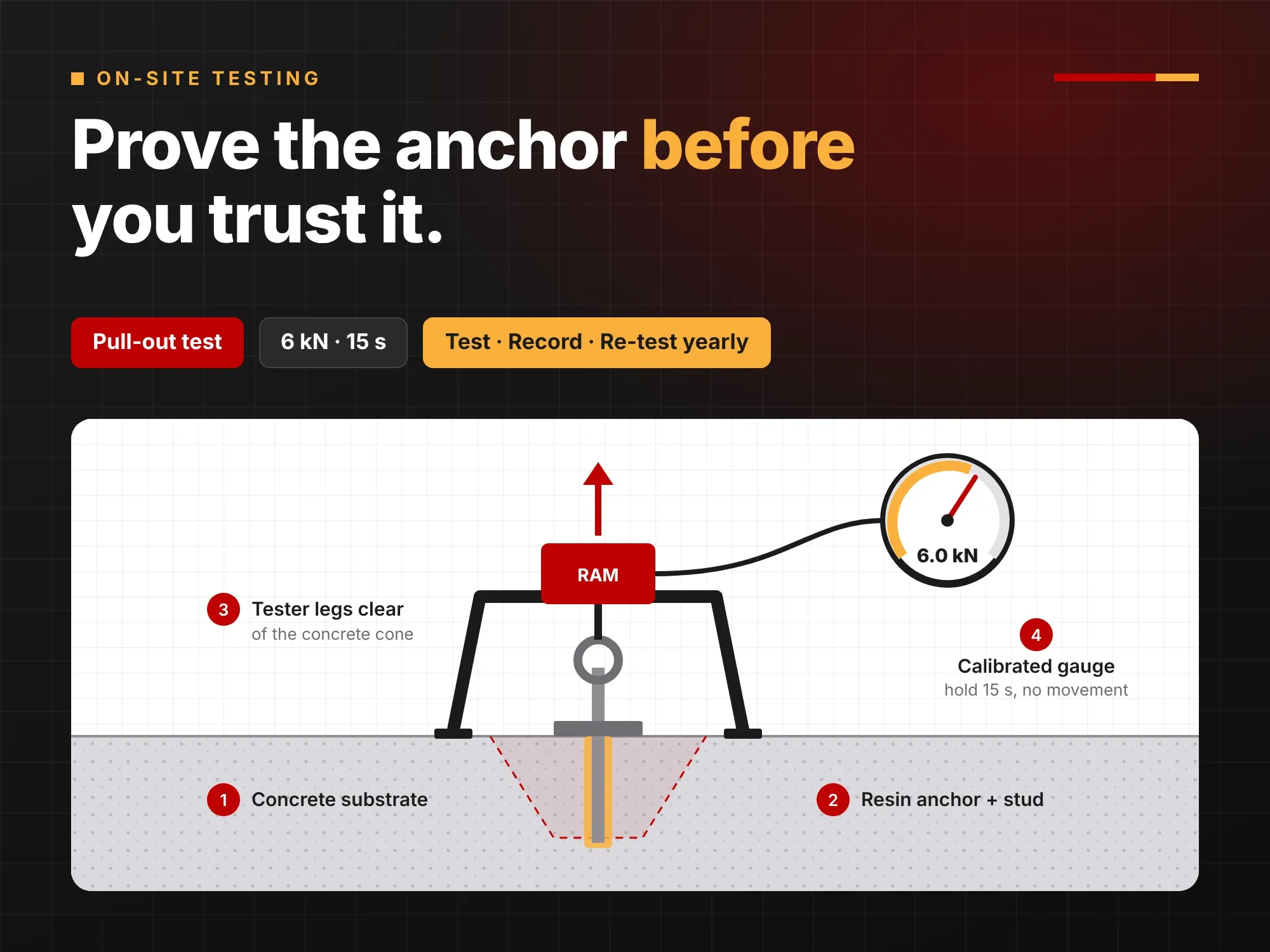
A pull-out test (also called a pull test, tension test or proof load test) applies a measured axial load to an anchor that is already installed in the structure. A portable hydraulic tester sits over the anchor with its legs on the surrounding surface. A pump raises the load while a gauge shows the force in kN. The tester watches for movement of the anchor, cracking of the base material, or a drop in the gauge reading.
There are two kinds of test, and they answer different questions:
| Test type | What it proves | When it is used | Load |
|---|---|---|---|
| Proof test (non-destructive) | The working anchor was installed correctly and holds its test load | After installation, on a sample or on every safety-critical anchor; at periodic inspection | A set load, below the anchor's capacity, held for a set time |
| Allowable resistance test (destructive, sometimes called a preliminary test) | What load the anchor can actually carry in this particular substrate | Before anchors are chosen, when there is no approval data for the base material (for example old brickwork or unknown concrete) | Increased until the anchor fails, on sacrificial test anchors installed away from the working ones |
Why pull-out testing matters
1. A certificate covers the anchor, not the installation
EN 795 and EN 17235 certificates prove that an anchor device performs when it is fixed as tested. They cannot prove that your anchor was drilled to the right depth, cleaned, filled with the right resin, cured for long enough and set into sound concrete. Most anchor failures in service trace back to installation and substrate, not to the anchor itself. The new EN 17235 standard for permanent anchors reflects this: it assesses the device together with its fixings and the supporting structure.
2. You cannot see a bad fixing
Under-drilled holes, dust left in the hole, resin that has not cured, the wrong embedment depth, or a fixing set close to an edge or a crack all look the same from the outside as a good fixing. A test load reveals them before a worker's life depends on them.
3. Substrates vary, even on one roof
Concrete strength, voids, rebar, hollow blocks, screeds and old masonry change from one bay to the next. A fixing that holds well in one area can fail a few metres away. Testing shows how the anchor performs in the material it is actually fixed into.
4. Anchors degrade over time
Corrosion, water ingress, freeze-thaw, vibration, roof works and building alterations all weaken fixings over the years. Periodic re-testing and inspection catch the anchor that was fine on day one but is no longer safe.
5. It gives you evidence
A test record with the load, hold time, result, tester and gauge calibration gives building owners, main contractors and inspectors documented proof that the system was verified. If an incident is investigated, that record matters.
What the standards say
- BS 7883 (code of practice for designing, installing and inspecting anchor systems used with EN 795 devices) and WAHSA guidance: anchor devices in solid structures are tested to 6 kN, held for 15 seconds, with no movement of the anchor and no damage to the structure. Anchors used for fall arrest are re-examined by a competent person at least every 12 months (every 6 months for rope access).
- BS 8539 (selection and installation of post-installed anchors in concrete and masonry): proof tests use the characteristic load multiplied by a factor of 1.5 when 2.5% of anchors are tested, or 1.25 when 5% are tested. The factor should never exceed 1.5. Where there is no approval data for the base material, allowable resistance tests to failure are carried out first.
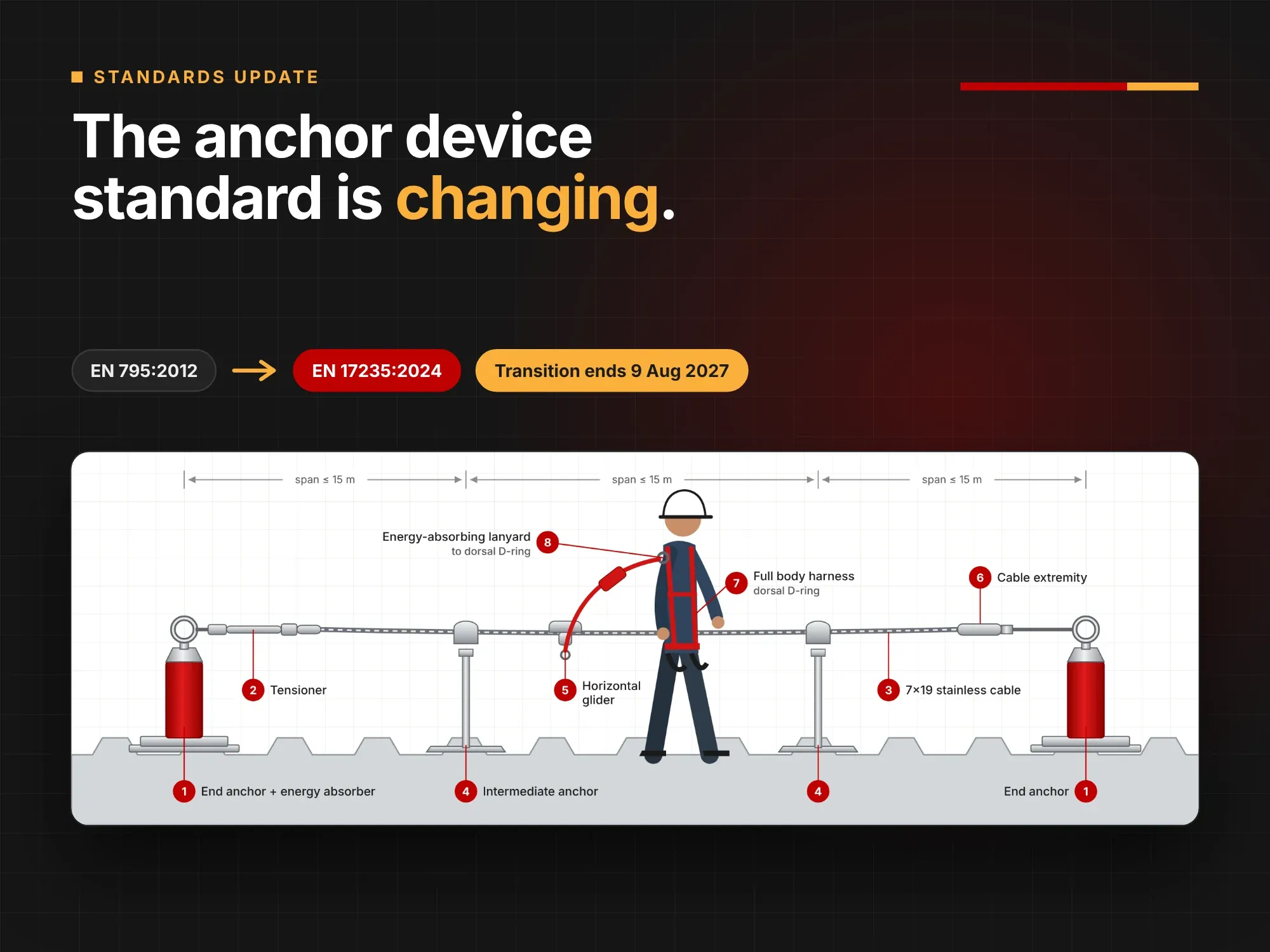
- EN 795:2012 (anchor devices) and EN 17235:2024 (permanent anchor devices): set the performance of the devices themselves. Groxx lifelines and anchors are designed to these standards; the installation still has to be verified on site.
- Manufacturer's instructions always come first. Some anchors specify their own test load, or must not be tested through certain parts.
Local regulations in Singapore, Malaysia, the Philippines and across the region generally require anchorages for work at height to be adequate for the load and inspected by a competent person. Pull-out test records are the usual way to show this.
How a proof test is carried out
- Check the equipment. Use a hydraulic tester rated above the test load, with a current calibration certificate for the gauge. Most testers are recalibrated every 12 months.
- Inspect first. Look for movement, cracking, corrosion and damage before any load is applied. Do not test an anchor that is already visibly defective.
- Set up correctly. Connect through the anchor point, as it would be loaded in use. Place the tester's legs clear of the anchor so they do not clamp the concrete around it and give a false pass.
- Apply the load smoothly. Raise the load steadily to the test value, without shock loading.
- Hold and watch. Hold the load for the specified time (for example 15 seconds at 6 kN). The anchor passes if the gauge holds and there is no movement or cracking.
- Record and tag. Record the anchor ID, location, load, hold time, result, date, tester and gauge serial number. Tag or mark the anchor and keep the report with the system's records.
- Act on failures. Take a failed anchor out of service at once, find out why, and increase the test sample for anchors installed the same way.
Choosing pull-out test equipment
- Capacity and resolution: choose a tester whose range covers your test loads with good resolution at 6 kN to 15 kN. A gauge reading in kN avoids conversion errors.
- Adaptors: you need adaptors for the anchors you test: eyebolts, threaded studs, D-rings and anchor posts.
- Bridge or legs: the support span must be wide enough to keep clear of the anchor's concrete cone.
- Calibration: buy from a supplier that can recalibrate and certify the gauge, and keep the certificate with every test report.
- Competence: the equipment is only as good as the person using it. Testers should be trained and competent, and independent of the installer where possible.
Pull-out testing with Groxx systems
Groxx anchor points, horizontal lifelines and vertical lifelines are supplied with installation instructions that state the fixings to use, such as the GRX Nugget chemical anchor and A4 stainless wedge anchors. Plan pull-out tests as part of commissioning and every annual inspection.
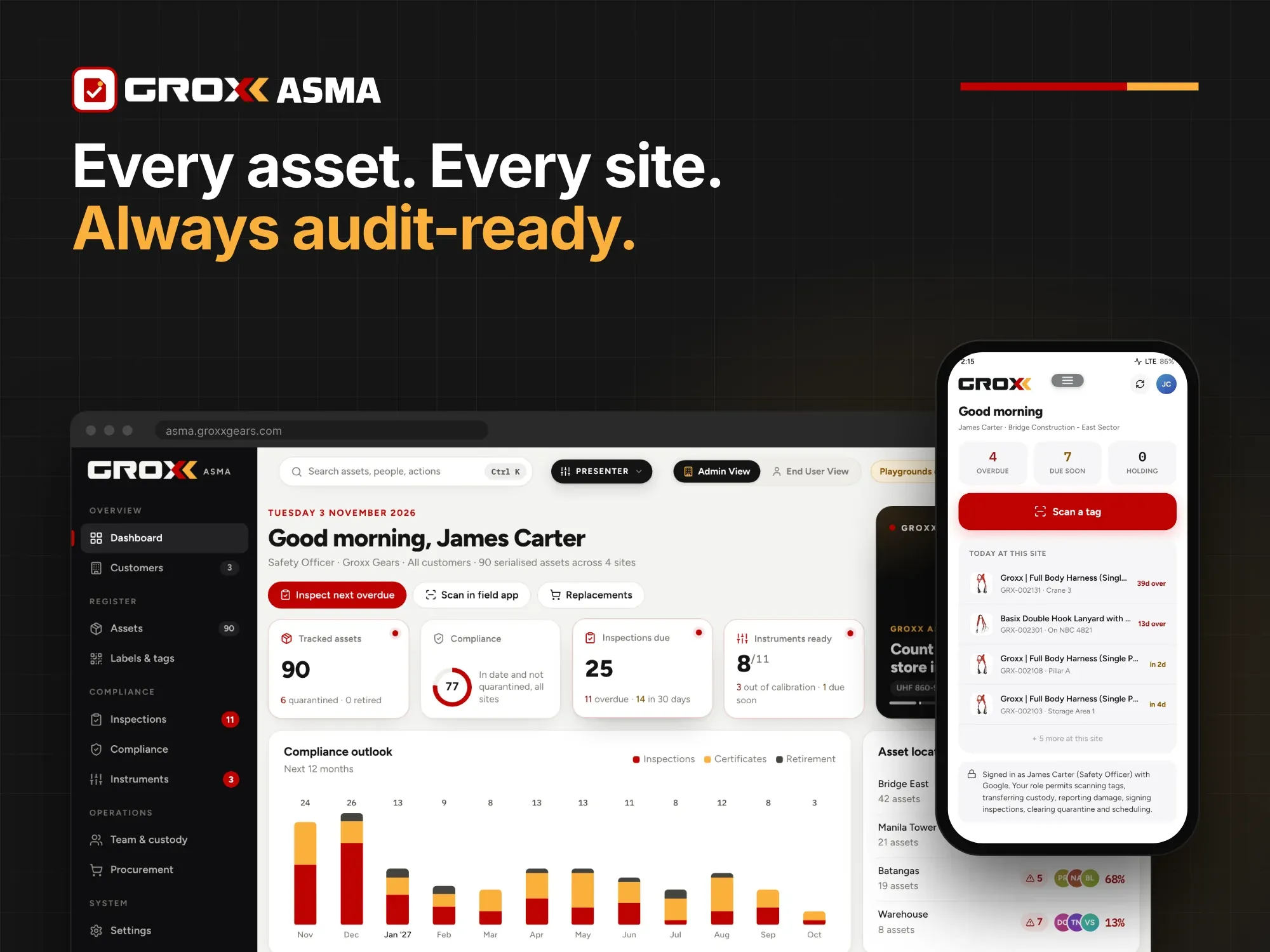
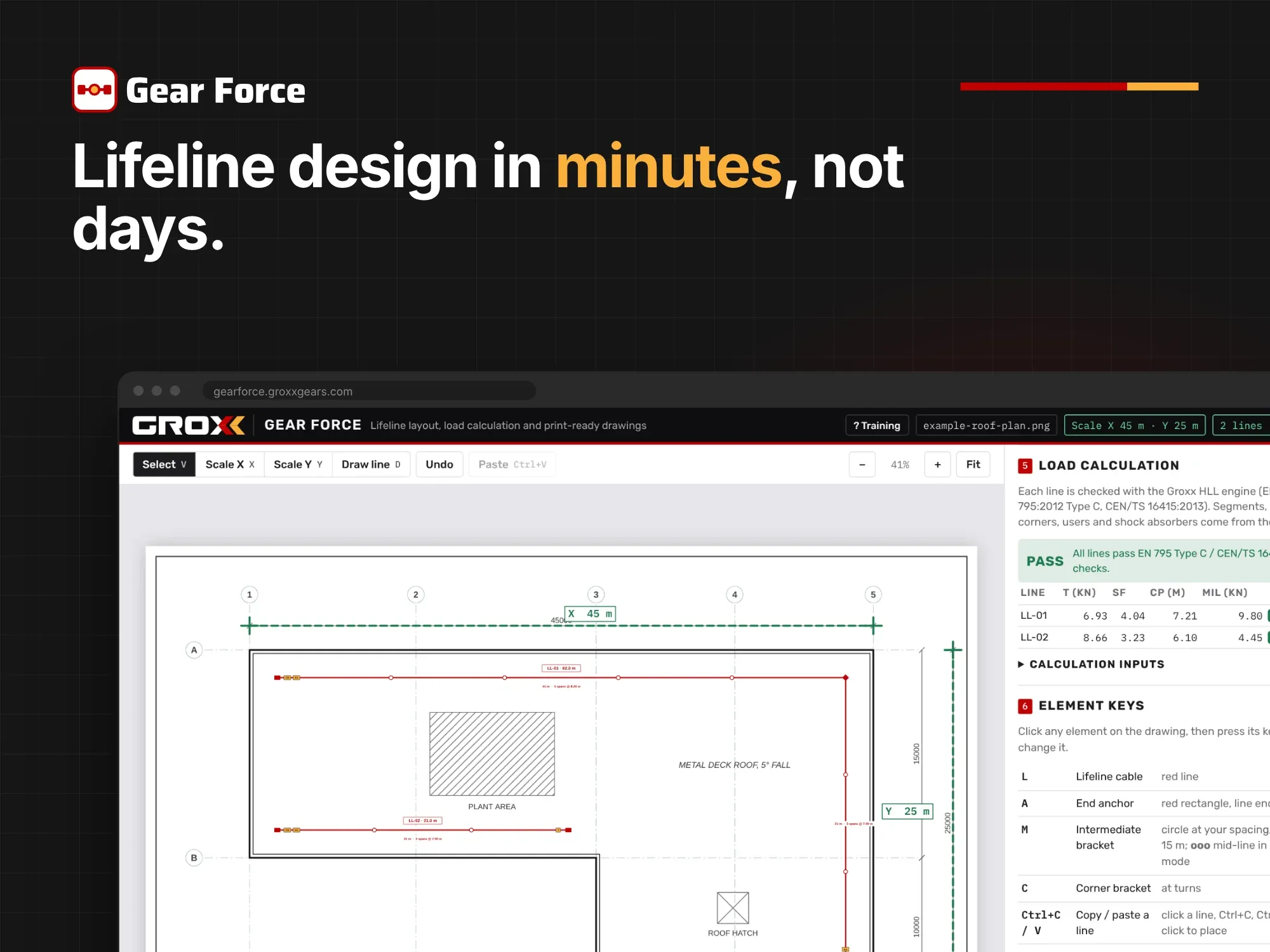
Use Groxx ASMA to schedule inspections and keep test results, photos and calibration certificates against each anchor, so the evidence is ready when an auditor or client asks for it. Use Groxx Gear Force to calculate the loads your lifeline puts on its end anchors before you choose fixings and test loads.
For help with fixings, test loads or test records for a Groxx system, contact our team.
Frequently asked questions
What is a pull-out test for anchors?
It is an on-site test in which a calibrated hydraulic tester applies a controlled tension load to an installed anchor to confirm that it holds without movement or damage to the structure.
What load should a fall protection anchor be pull tested to?
UK guidance in BS 7883 and from WAHSA uses 6 kN held for 15 seconds for anchor devices in solid structures. Always check the anchor manufacturer's instructions, which may specify a different test load.
How often should anchors be pull tested?
Test after installation, then re-examine anchors used for fall arrest at least every 12 months, or every 6 months for rope access. Test more often if the anchor is exposed to harsh conditions or the structure has changed.
Does a pull test damage the anchor?
A proof test is non-destructive: the test load is set below the anchor's capacity, so a sound anchor is not damaged. Allowable resistance tests do load anchors to failure, so they are done on separate test anchors, never on the working ones.
Who can carry out a pull-out test?
A competent person who is trained in the test method and the equipment, ideally independent of the installer, using a tester with a current calibration certificate.
Is a pull-out test enough on its own?
No. It checks the fixing at the moment of the test. Combine it with correct design, the right fixings, supervised installation, visual inspection and regular re-examination.
This article summarises published guidance, including BS 7883, BS 8539 and WAHSA Technical Guidance Note 6, as of November 2026. It is general information, not a substitute for the standards, the manufacturer's instructions or advice from a competent engineer for your site.